
Common Reasons Referrals to Dietitians Get Delayed — And Why That Matters
At Nurtari, we believe healing happens when care is collaborative, integrated, and responsive. Yet one of the most common patterns we see in both medical and mental health settings is delayed referrals to a registered dietitian (RD).
Often, it’s not intentional. It’s not neglect. It’s hesitation, uncertainty, or the belief that “we’ll get to that later.”
But when nutrition support is postponed, the consequences can quietly compound.
Let’s talk about why referrals get delayed — and why timing matters more than many realize.
1. “It’s Not That Bad Yet”
This is perhaps the most common reason.
A client may show:
Mild food restriction
Subtle weight changes
GI complaints
Fatigue
Increasing rigidity around food
Compensatory movement behaviors
It may not meet full criteria for an eating disorder. Labs may still be “within range.” Weight may not yet look alarming.
But nutritional patterns often deteriorate gradually. Waiting until behaviors escalate or medical markers worsen means the nervous system has already adapted to chronic stress and deprivation. By the time it feels “serious enough,” the work is often more complex and recovery takes longer.
Early intervention prevents escalation.
2. “Let’s Focus on Therapy First”
Therapy is vital. And as clinicians, it often feels most urgent.
But nutrition and mental health are not sequential — they are interdependent.
Undernourishment can:
Increase anxiety and depression
Reduce cognitive flexibility
Heighten irritability
Impair emotional regulation
Worsen trauma symptoms
When the brain is under-fueled, therapy can stall. Clients may intellectually understand concepts but struggle to integrate them. Nutritional stabilization frequently enhances therapeutic progress rather than competing with it.
It’s not therapy or nutrition. It’s both.
3. Fear of Overwhelming the Client
Sometimes providers hesitate to add “one more appointment” to a client’s plate. Especially if they’re already juggling therapy, psychiatry, medical appointments, and work.
The intention is compassionate — to avoid overload.
However, when food and body distress are active stressors, adding specialized support often reduces overwhelm rather than increases it. Clients no longer have to navigate confusing nutrition advice, internet misinformation, or rigid rules alone.
A trauma-informed RD can:
Provide clarity
Reduce shame
Normalize patterns
Create structure without rigidity
Support can actually lighten the load.
4. Weight Bias and Misconceptions
Dietitian referrals are sometimes delayed when a client:
Is in a higher-weight body
Does not appear medically fragile
Does not fit stereotypical eating disorder presentations
We know eating disorders and disordered eating occur across all body sizes. We also know that malnutrition is not defined by BMI alone.
When referrals are based solely on visible weight changes, we risk missing:
Chronic restriction masked as “clean eating”
Binge–restrict cycles
Compensatory movement patterns
Medical instability at any size
Nutrition support is about relationship with food, body, and nourishment — not just weight.
5. “They Should Be Able to Figure This Out”
Food is something everyone does every day. It can seem simple on the surface.
But nutrition becomes deeply complex when layered with:
Trauma history
Control dynamics
Sensory sensitivities
Medical conditions
Cultural messaging
Body image distress
Registered dietitians trained in eating disorders and trauma-informed care bring clinical expertise that extends far beyond meal planning. They understand metabolic adaptation, medical risk, refeeding, GI recovery, and how to support behavior change without reinforcing shame.
Why Timing Matters
Delayed referrals can mean:
Longer recovery timelines
Increased medical risk
Entrenched patterns
Greater emotional distress
Higher levels of care later
Early, coordinated intervention leads to:
More efficient progress
Reduced symptom severity
Better treatment engagement
Lower long-term cost (emotionally and financially)
At Nurtari, we believe in addressing concerns when they are whispers — not waiting until they are crises.
The Power of In-House, Coordinated Care at Nurtari
One of the most significant barriers to timely referral is logistics. When providers must send clients externally, there can be:
Long waitlists
Scheduling delays
Limited communication between providers
Fragmented treatment goals
This is where in-house collaboration changes outcomes.
At Nurtari, our therapists and registered dietitian work closely together as part of the same team. This means:
Shared treatment planning
Ongoing communication (with client consent)
Consistent messaging
Early identification of medical or behavioral risk
Integrated support for both nervous system and nourishment
The therapist has direct access to the RD’s schedule. If nutrition support is indicated, appointments can be scheduled immediately — often during the therapy session itself. Clients do not have to search for outside providers, navigate waitlists, or retell their story multiple times.
They can also contact Nurtari directly to begin nutritional support right away.
This immediacy matters.
When care is accessible and aligned:
Clients are more likely to follow through
Momentum is preserved
Patterns are addressed earlier
Shame decreases
Outcomes improve
Coordinated, in-house care reduces fragmentation and increases safety — clinically and emotionally.
Nutrition Support Is Not Just for Eating Disorders
Referrals are appropriate when a client is experiencing:
An unhealthy relationship with food, body, or movement
Chronic dieting or weight cycling
Emotional eating or loss of control eating
GI distress connected to stress or trauma
Medical diagnoses requiring nutrition support
Hormonal imbalances or fatigue
Desire for sustainable weight loss in a non-shaming, evidence-based way
If food, body, or nourishment feels stressful, rigid, chaotic, or confusing — that alone deserves attention.
If you’re a provider, consider this an invitation: refer earlier than you think you need to.
If you’re a client and something about food, your body, or movement feels off — you don’t have to wait until it’s “bad enough.”
At Nurtari, we make coordinated care simple. You can begin therapy, nutrition services, or both — without delay.
Early support isn’t dramatic. It’s preventative. It’s compassionate. And it works.
Because healing deepens when all parts of you are nourished.
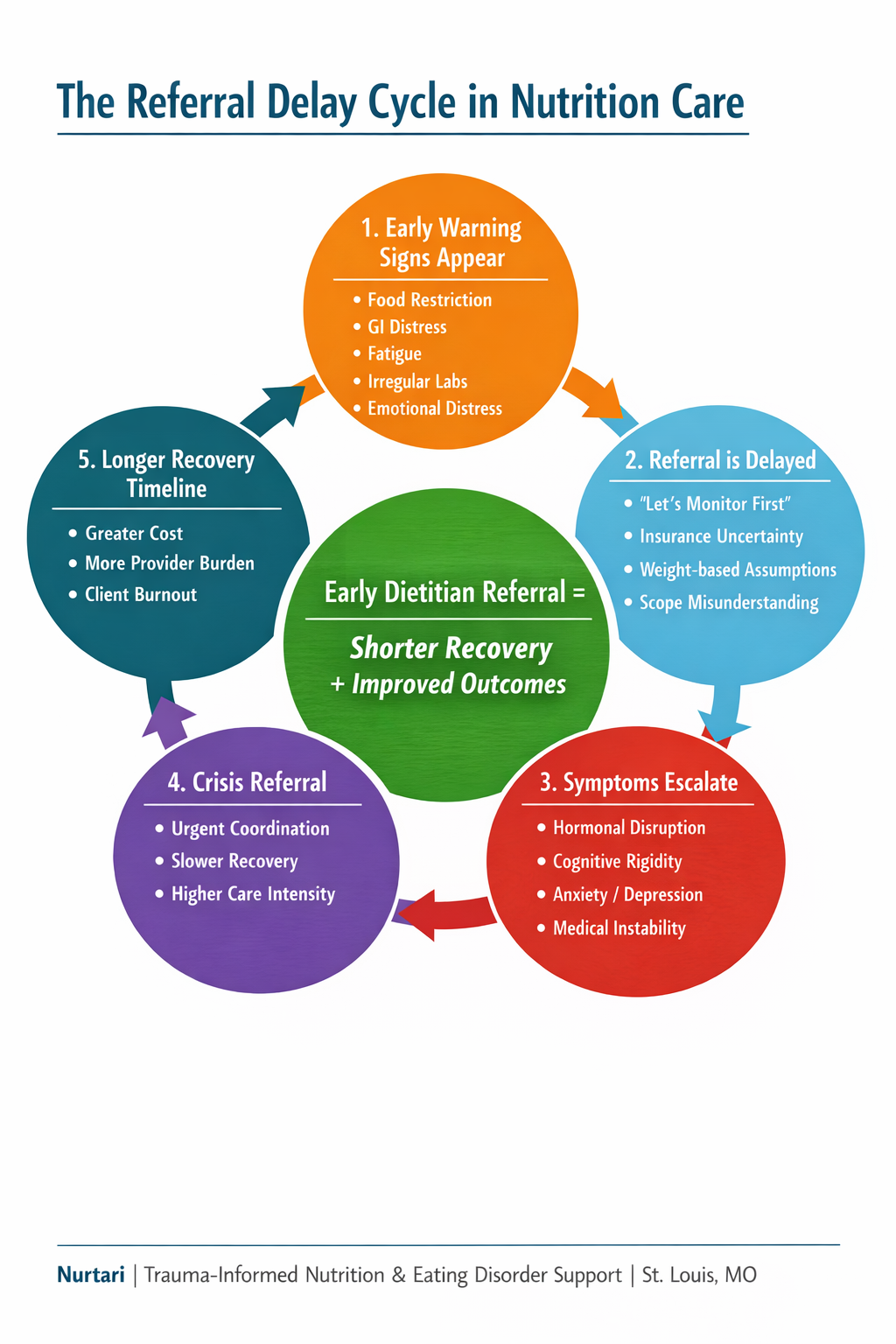
Referral Delay Cycle in Nutrition Care
Strengthening Collaborative Care in St. Louis
In the St. Louis healthcare community, strengthening collaboration between therapists, physicians, OB/GYNs, endocrinologists, psychiatrists, and registered dietitians can dramatically improve early intervention outcomes.
At Nurtari, we prioritize trauma-informed nutrition care and collaborative treatment planning to reduce referral delays and improve client outcomes throughout St. Louis and surrounding communities.
Looking for a Registered Dietitian in St. Louis?
If you're a St. Louis provider seeking collaborative care — or a client wondering whether nutrition support may help — we welcome connection.
Nurtari | Trauma-Informed Nutrition Services
St. Louis, Missouri
In-person sessions available in St. Louis, MO, virtual sessions available
314-279-9751
info@nurtari.com
www.nurtari.com